Research-led product guide
Innova 5610 Bidirectional OBD2 Scanner: the answer in context
A bidirectional scanner can do more than listen: on supported vehicles it can send a command to a module and request an action from a component or system. That may help test a cooling fan, fuel-pump circuit, valve, solenoid, light, or other supported function. The command is only one step in diagnosis, and coverage varies by vehicle. The category is valuable when the operator has a defined test plan, service information, and safe working conditions.
- Read-only scan
- Retrieves codes, status, and data reported by vehicle modules
- Bidirectional test
- Requests a supported action from a vehicle system or component
- What it proves
- Whether the commanded system responds under the test conditions—not automatically which part failed
- Coverage rule
- Verify the exact active test for the exact vehicle before buying
- Safety rule
- Follow vehicle service information and avoid unfamiliar safety-critical procedures
Our view is based on published specifications, manufacturer documentation, and category research. Where we have not performed hands-on testing, we do not imply that we have.
What bidirectional means
The scanner can ask the vehicle to act, not just report
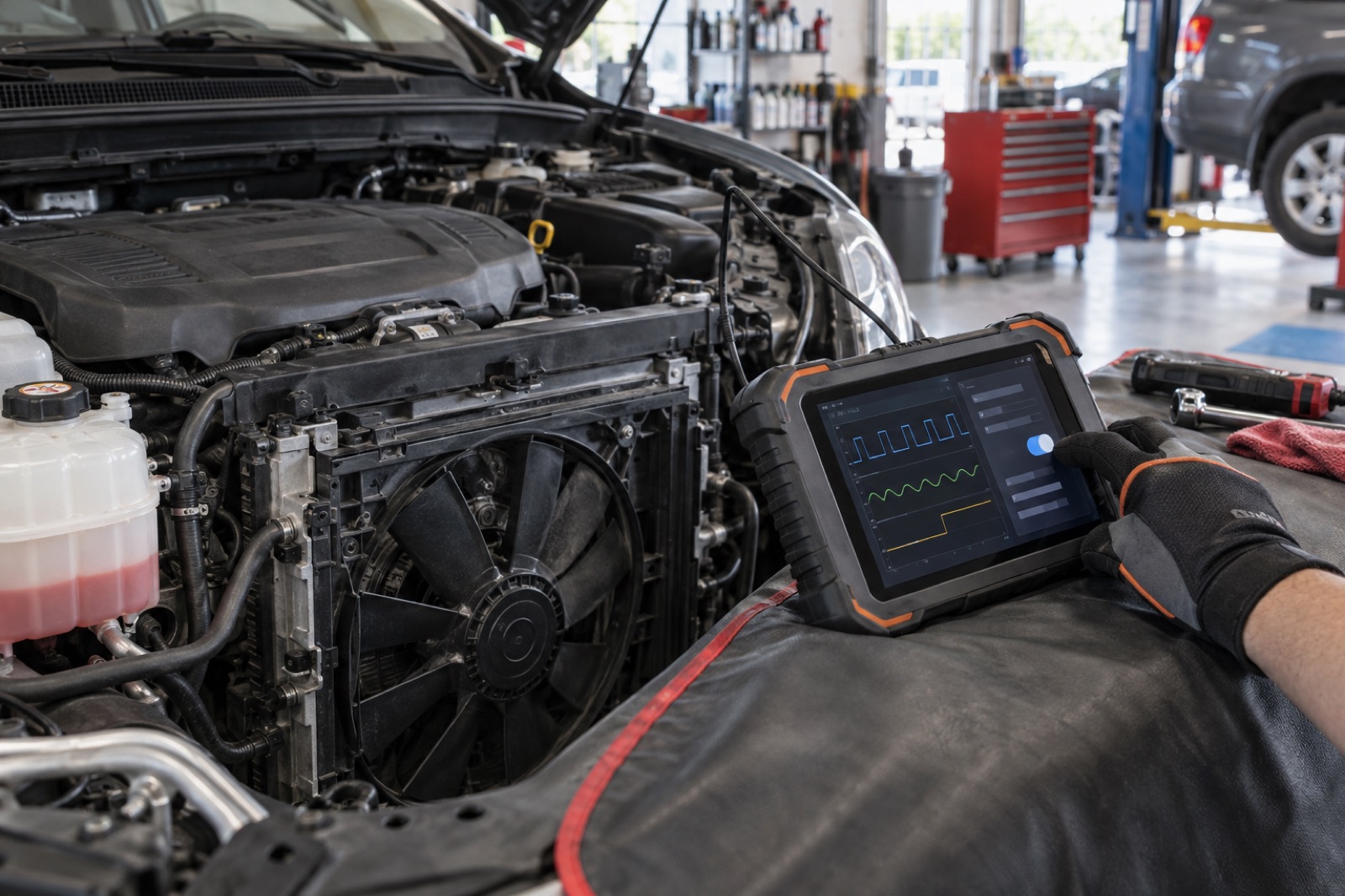
A basic OBD2 reader receives diagnostic information: stored and pending codes, readiness status, freeze-frame data, and supported live parameters. A bidirectional tool adds the ability to send certain supported commands back through a control module. Innova describes examples such as switching a fuel pump or cooling fan on and off and commanding other supported devices for testing.
That difference can shorten a diagnostic path. Instead of waiting for operating conditions to trigger a fan, for example, a technician may request the fan through the scanner and observe the response. But a successful command does not prove that every part of the system is healthy, and a failed response does not identify the failed link by itself.
The scanner, module, wiring, power supply, ground, relay, actuator, mechanical load, operating prerequisites, and vehicle security rules can all affect the result. Active testing produces evidence; measurement and service information turn that evidence into a diagnosis.
- Use a command to test a defined hypothesis
- Observe both scanner feedback and physical response
- Confirm with measurements before replacing parts
Useful active tests
The best use case is a component that can be commanded safely and observed clearly
Cooling fans, fuel-pump relays, purge valves, lamps, injectors, solenoids, windows, and selected braking or service systems are common examples in manufacturer literature, but the available list depends on the vehicle. A useful active test has a clear prerequisite, command, expected response, and follow-up measurement.
Suppose a cooling fan does not operate when commanded. The next steps could include checking relevant data, fuses, relay control, voltage, ground, wiring, and the motor itself. Replacing the fan immediately would skip the main value of bidirectional diagnosis: narrowing the fault with evidence.
Some routines do more than toggle a component. ABS bleeding, electronic parking-brake service, relearns, resets, and calibrations may require a precise sequence, safe support, correct fluid or mechanical work, and vehicle-specific instructions. Do not treat every menu item as a casual experiment.
Coverage and safety
“Bidirectional” is a category—not a promise of every command on every car
Innova explicitly warns that the 5610’s functions vary by year, make, and model. Before buying any bidirectional scanner, search its coverage tool for the exact vehicle and exact command. A general statement that the tool supports active tests is not enough when the purchase depends on one particular test or service routine.
Active commands may start motors, move actuators, change idle behavior, operate pumps, or alter a service state. Secure the vehicle, keep hands and loose items away from moving parts, provide ventilation when required, and follow the vehicle’s service information. Braking, restraint, high-voltage, immobilizer, and calibration work may deserve trained professional service.
We have not independently performed the listed Innova 5610 active tests. Our analysis uses current official product and educational material and avoids treating advertised examples as universal vehicle coverage.
Who should buy one
Pay for active tests only when they fit your recurring work
A bidirectional scanner fits an experienced DIY owner who maintains supported vehicles, understands basic electrical diagnosis, uses service information, and can name the active tests or routines that will save time. The Innova 5610 belongs on that shortlist when its coverage checker confirms those functions and a standalone handheld workflow is preferred.
A basic reader remains the rational choice for checking engine codes, emissions readiness, and a small set of live parameters. BlueDriver can suit owners who want app-based repair context and supported enhanced-system codes without moving into active controls. The more advanced tool is not automatically the better personal tool.
Compare coverage, update policy, subscriptions, interface, regional support, seller, warranty, return period, and required accessories. Most importantly, compare the tool with the diagnostic work you will actually perform rather than the longest feature list.
Frequently asked questions
What buyers ask about Innova 5610 Bidirectional OBD2 Scanner
What is a bidirectional OBD2 scanner?
It is a diagnostic scanner that can read vehicle information and also send supported commands to certain modules or components for active testing.
Can a bidirectional scanner tell me exactly which part is bad?
Not by itself. A command and the resulting response are diagnostic evidence; wiring, power, ground, module logic, mechanical conditions, and prerequisites still need testing.
Do active tests work on every vehicle?
No. Available commands vary by tool, year, make, model, module, configuration, region, software, and security architecture. Check the exact vehicle and function.
Is the Innova 5610 bidirectional?
Innova documents supported bidirectional system tests for the 5610, but the exact commands vary by vehicle and must be confirmed in the official coverage checker.
Do most drivers need a bidirectional scanner?
Many do not. A basic reader or app-based scanner is sufficient when the recurring need is code retrieval, emissions readiness, and basic data rather than active diagnosis.
Primary sources checked
Official documentation used for this guide
Specifications, software, bundles, warranties, and compatibility can change. These primary sources were checked while preparing this page; confirm the current information for the exact model before purchase.
Product links