Editorial briefing
What matters now
These machines suit frequent ice users who accept regular draining and cleaning.
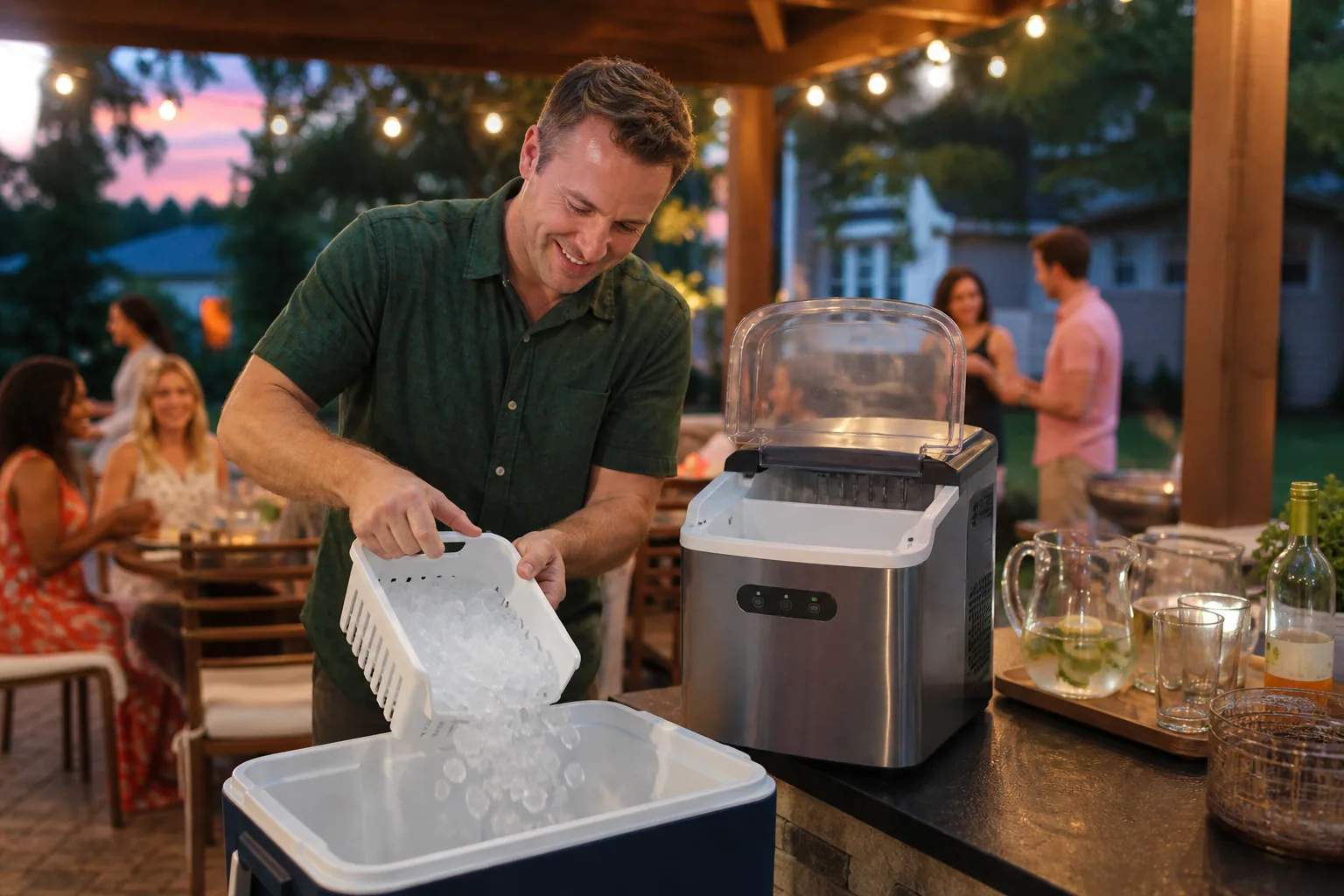
For entertaining and drink stations and homes with limited freezer ice output, the category can be useful. The deciding factor is whether the product’s strongest benefit shows up often enough to justify its footprint, setup, and upkeep.
Evidence desk
Claims, context, consequence
Translate this into a real consequence for fit, compatibility, maintenance, or everyday handling before giving it weight.
Translate this into a real consequence for fit, compatibility, maintenance, or everyday handling before giving it weight.
Translate this into a real consequence for fit, compatibility, maintenance, or everyday handling before giving it weight.
Our view is based on published specifications, manufacturer documentation, and category research. Where we have not performed hands-on testing, we do not imply that we have.
The deeper read
Countertop ice makers in context
Our category desk identifies four pieces of context that should sit beside the published claims.
Measure the working space
Counter width is only the first dimension. Doors, baskets, lids, water tanks, cords, vents, handles, and removable parts all need room during operation and cleaning. Mark the full working footprint with tape, then check whether nearby cabinets, walls, heat-sensitive surfaces, and outlets allow the manufacturer’s required clearance.
Cleaning determines frequency of use
An appliance can save ten minutes during operation and give them back during cleanup. Look at the number of removable parts, narrow channels, coatings, drainage, filter access, drying needs, and whether components are dishwasher-safe under the current instructions. The easiest routine is the one you can complete immediately after use.
Capacity claims need translation
Outer volume, basket volume, water-tank size, room coverage, and production-per-day figures do not always describe the usable amount in one cycle. Translate the claim into meals, cups, rooms, bins, or cleaning sessions for your household. A smaller machine used once can be more efficient than a compact machine that needs repeated batches.
Ownership continues after purchase
Filters, descaling products, bags, brushes, seals, replacement baskets, and warranty service can shape long-term value. Check whether consumables are widely available and whether the machine can be maintained without unusual tools. A low purchase price is less persuasive when a proprietary part is costly or difficult to source.
Turn the guide into a shortlist
A buying guide should reduce the field, not encourage endless comparison. For countertop ice makers: convenience with a cleaning routine, start with three non-negotiables: the environment it must fit, the primary task it must complete, and the ownership burden you will accept. Remove every option that fails one of those conditions before looking at premium features. A shortlist of two or three well-matched products is more useful than a ranking of ten products built for different people.
Next, write one sentence for the compromise attached to each finalist. Perhaps the smallest option needs more frequent batches, the wireless option gives up some efficiency, or the higher-output model occupies more room. When the compromise is explicit, the choice becomes personal in a productive way. You are no longer asking which product is best in the abstract; you are deciding which drawback will appear least often in your routine.
Before checkout, confirm the precise model, included accessories, seller identity, regional warranty, delivery and return terms, and the latest manufacturer instructions. Save important compatibility information when it affects the decision. If a safety, electrical, food-contact, charging, installation, or vehicle requirement applies, the current official instructions take priority over a general guide. The last step is permission to wait: uncertainty is a valid reason not to buy yet.
The counterpoint
Fast production does not mean long-term frozen storage; finished ice generally needs to move to a freezer.
Enthusiasm is easy when every benefit is listed together. A better editorial test is to isolate the drawback and ask how often it will appear. A compromise encountered daily deserves more weight than a premium feature used occasionally.
Three things to carry into the decision
- Confirm the exact model, dimensions, compatibility, and included pieces.
- Compare total ownership—including accessories, consumables, storage, and maintenance.
- Choose for the primary routine and let secondary features break genuine ties.
The LumeSift take: clarity comes from removing choices that do not fit, not from finding a product with no compromises.