Editorial briefing
What matters now
Start with room size, connection needs, and listening distance before comparing wattage or driver counts.
For near-field listening and small workspaces, the category can be useful. The deciding factor is whether the product’s strongest benefit shows up often enough to justify its footprint, setup, and upkeep.
Evidence desk
Claims, context, consequence
Translate this into a real consequence for fit, compatibility, maintenance, or everyday handling before giving it weight.
Translate this into a real consequence for fit, compatibility, maintenance, or everyday handling before giving it weight.
Our view is based on published specifications, manufacturer documentation, and category research. Where we have not performed hands-on testing, we do not imply that we have.
The deeper read
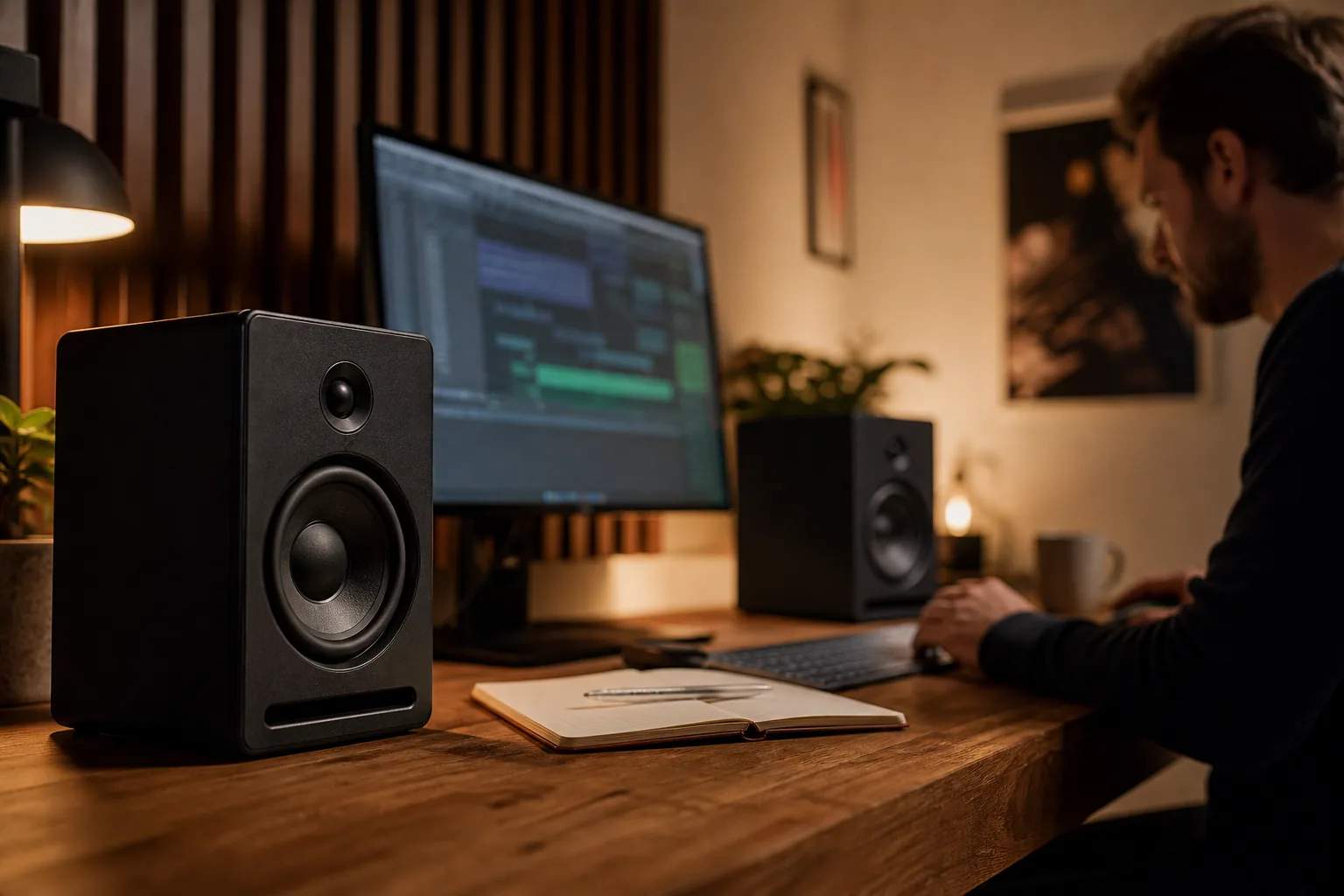
The desk speakers worth shortlisting in context
Our category desk identifies four pieces of context that should sit beside the published claims.
Ergonomics comes before the spec sheet
A product used for hours must fit the body and the desk. Clamp pressure, key spacing, control reach, eye line, speaker distance, microphone position, and cable movement affect comfort and consistency. Measure the setup while seated in the normal working position, not from an empty desk.
The room is part of the system
Sound, video, and voice quality change with walls, windows, desk reflections, lighting, fans, keyboards, and distance. Hardware cannot fully compensate for poor placement. Before upgrading, try moving the current device, improving front lighting, softening a reflective room, or placing a microphone closer to the speaker.
Connections shape the workflow
Bluetooth profiles, USB support, analog inputs, device switching, operating-system controls, and companion apps determine how smoothly equipment moves between work and personal use. List the devices that need to connect and the order in which they are used. A missing input or awkward switch can outweigh a premium feature.
Judge the long session
A five-minute demonstration can hide fatigue, battery anxiety, hot ear cups, awkward shortcuts, unstable mounts, and distracting indicator lights. Consider a complete meeting, editing session, flight, or workday. Controls should be easy to find without looking, and the product should recover gracefully when a connection or application changes.
Turn the guide into a shortlist
A buying guide should reduce the field, not encourage endless comparison. For the desk speakers worth shortlisting, start with three non-negotiables: the environment it must fit, the primary task it must complete, and the ownership burden you will accept. Remove every option that fails one of those conditions before looking at premium features. A shortlist of two or three well-matched products is more useful than a ranking of ten products built for different people.
Next, write one sentence for the compromise attached to each finalist. Perhaps the smallest option needs more frequent batches, the wireless option gives up some efficiency, or the higher-output model occupies more room. When the compromise is explicit, the choice becomes personal in a productive way. You are no longer asking which product is best in the abstract; you are deciding which drawback will appear least often in your routine.
Before checkout, confirm the precise model, included accessories, seller identity, regional warranty, delivery and return terms, and the latest manufacturer instructions. Save important compatibility information when it affects the decision. If a safety, electrical, food-contact, charging, installation, or vehicle requirement applies, the current official instructions take priority over a general guide. The last step is permission to wait: uncertainty is a valid reason not to buy yet.
The counterpoint
Compact speakers protect desk space, while larger cabinets generally offer more low-end reach.
Enthusiasm is easy when every benefit is listed together. A better editorial test is to isolate the drawback and ask how often it will appear. A compromise encountered daily deserves more weight than a premium feature used occasionally.
Three things to carry into the decision
- Confirm the exact model, dimensions, compatibility, and included pieces.
- Compare total ownership—including accessories, consumables, storage, and maintenance.
- Choose for the primary routine and let secondary features break genuine ties.
+ Desk-friendly format
+ Simple wired setup
− Not designed to fill large rooms
− No built-in streaming
The LumeSift take: clarity comes from removing choices that do not fit, not from finding a product with no compromises.
Product links